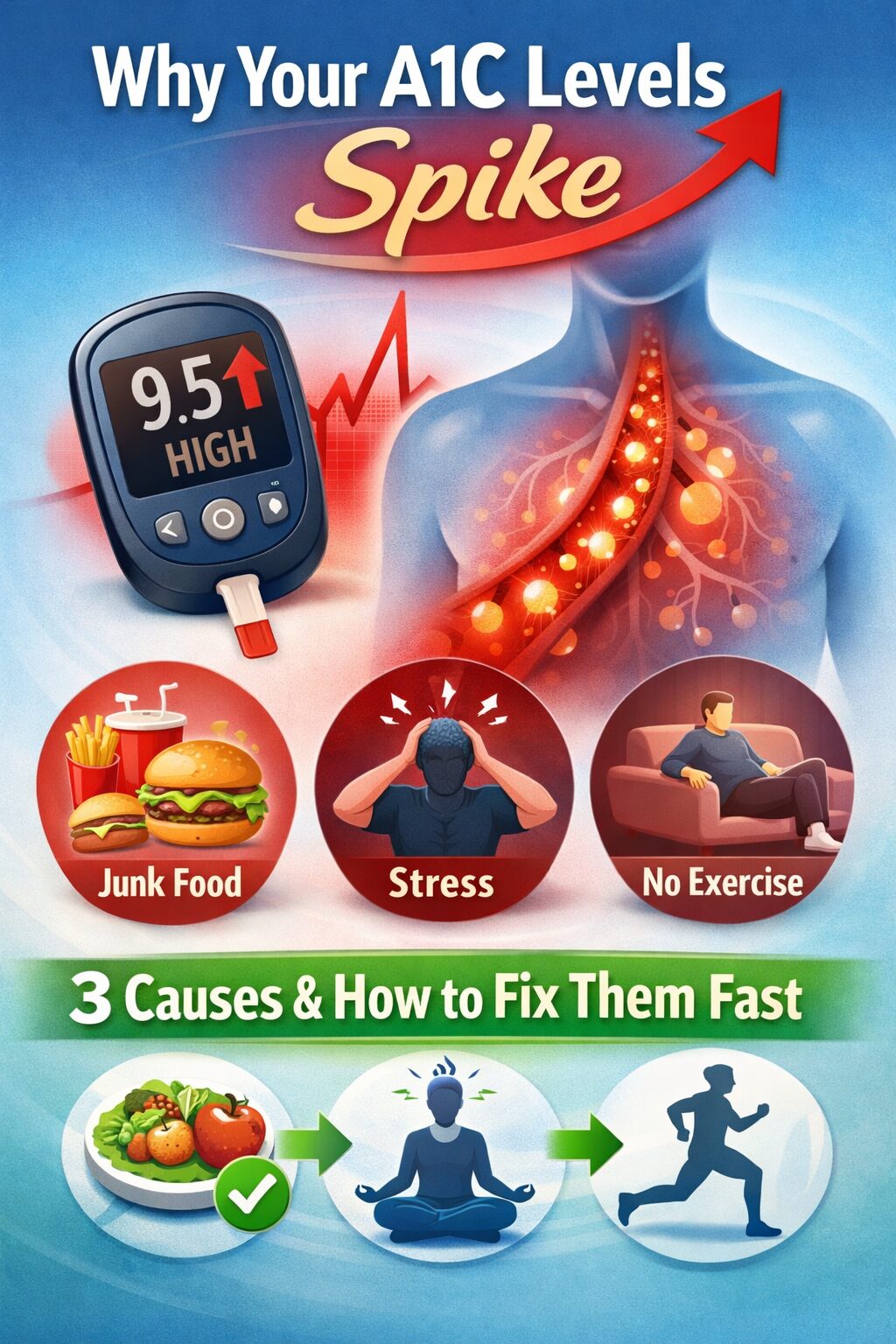
3 Reasons Why A1C Levels Spike And How to Fix It Fast
Learn 3 key reasons why A1C levels spike and how to fix it fast using diet, lifestyle changes, and blood sugar control strategies.
Read DISCLAIMER
The material presented here is for general informational and educational purposes only and is not medical advice. Although we attempt to provide current and accurate information, this blog should not be used as a replacement for professional medical consultation, diagnosis, or treatment. In all cases, consult your physician or an accredited medical practitioner with regards to any medical condition or treatment. Do not ignore professional medical advice or wait for it on the basis of information provided by this blog. In a medical emergency, call emergency services immediately.
When you receive an A1C result that is higher than expected, it feels like a personal judgment on your willpower. You’ve been watching your sugar, maybe even taking your medication religiously, yet the number has crept up.
But in 2026, we understand that A1C is not just a “sugar score.” It is a 90-day average of your body’s total stress and metabolic burden. There are times when your diet is perfect, but your biology is fighting a different battle entirely.
If your A1C has spiked unexpectedly, it usually comes down to these three “silent” drivers—and luckily, they are things we can address without radical measures.
- The “Cortisol Creep” (Chronic Stress)
We often think of stress as a feeling in our head, but to your liver, stress is a command to dump sugar. When you are under chronic pressure—whether it’s work, family, or even the physical stress of a long-term injury—your body releases cortisol and adrenaline.
These hormones tell your body, “We’re in trouble; we need energy now.” Even if you aren’t eating sugar, your liver will manufacture it and release it into your bloodstream to prepare you for “fight or flight.” Over three months, these constant, stress-driven micro-spikes add up to a significantly higher A1C.
- The Fix: You can’t always remove the stressor, but you can change your body’s response. Five minutes of deep diaphragmatic breathing before bed and after lunch can physically signal your nervous system to exit “fight or flight.” It’s not “woo-woo”; it’s a manual override for your hormones.
- The “Short-Sleep” Resistance
In 2026, we’ve found that even one or two nights of poor sleep (less than 6 hours) can make your cells as insulin-resistant as someone with full-blown diabetes for the following 24 hours. When you don’t sleep, your body’s ability to move sugar out of your blood and into your muscles drops by about 20-30%.
If you’ve spent the last 90 days “powering through” on caffeine and late nights, your A1C will reflect that “leaky” metabolism. Your body is simply too tired to process the energy you’re giving it.
- The Fix: Prioritize a 7-hour minimum for two weeks. If you can’t get more sleep, try to make the sleep you do get higher quality by cooling your room to 18°C and cutting out blue light an hour before bed.
- The “Hidden” Anemia Factor
This is the one almost no one talks about. A1C measures the sugar stuck to your red blood cells. If you are iron-deficient or have certain types of anemia, your red blood cells actually live longer than the usual 90 days.
Because they are “hanging around” in your body longer, they have more time to collect sugar. This can result in a “false high” A1C—your blood sugar might actually be fine, but the test is being skewed by the age of your blood cells.
- The Fix: If your A1C is high but your daily finger-prick or CGM tests are normal, ask your doctor for a Ferritin and Iron panel. Correcting a simple iron deficiency can sometimes “drop” your A1C by half a point or more within a few months, simply by normalizing your blood cell turnover.
A Quiet Reflection
An A1C spike is a data point, not a destination. It’s your body’s way of tapping you on the shoulder and saying, “I’m struggling to keep up with the pace.” Instead of cutting more calories—which can actually increase your stress—try looking at your “rest” and your “breath” first. Often, the fastest way to lower your A1C isn’t found in what you take away from your plate, but in what you give back to your nervous system.
FAQs
- What does it mean when A1C levels spike?
A spike in A1C means your average blood glucose has increased over the past two to three months, signaling poorer long-term blood sugar control. - Can A1C rise suddenly even without diet changes?
Yes, factors like stress, illness, poor sleep, or medication changes can elevate blood sugar and raise A1C even if diet remains unchanged. - How quickly can A1C levels increase?
Because A1C reflects recent glucose patterns, significant blood sugar elevations over several weeks can cause noticeable increases. - Does stress really affect A1C levels?
Chronic stress raises cortisol, which increases blood glucose and contributes to higher A1C levels over time. - Can lack of sleep cause A1C to spike?
Poor or irregular sleep disrupts insulin sensitivity, leading to higher fasting and post-meal blood sugar levels. - How do refined carbohydrates affect A1C?
Frequent intake of refined carbs causes repeated glucose spikes, increasing the overall glucose average reflected in A1C. - Can reduced physical activity raise A1C?
Yes, inactivity decreases glucose uptake by muscles, causing blood sugar to remain elevated longer after meals. - Do infections or illness affect A1C readings?
Illness triggers inflammatory and stress responses that raise blood sugar, which can temporarily elevate A1C. - Can medications cause higher A1C levels?
Certain medications, including steroids and some psychiatric drugs, can increase blood glucose and raise A1C. - Is weight gain linked to rising A1C?
Weight gain, especially around the abdomen, increases insulin resistance and contributes to higher A1C levels. - Can dehydration influence A1C levels?
Dehydration concentrates blood glucose, potentially affecting glucose readings and long-term control. - How fast can lifestyle changes lower A1C?
Consistent improvements in diet, activity, and sleep can begin lowering A1C within 8–12 weeks. - Is it possible to lower A1C without medication?
Many people with prediabetes or early type 2 diabetes can lower A1C through lifestyle changes alone. - When should medication be considered for high A1C?
Medication may be necessary if A1C remains high despite sustained lifestyle efforts, under medical supervision. - What is the safest way to fix high A1C fast?
Combining balanced nutrition, regular physical activity, stress reduction, and consistent sleep is the safest and most effective approach.
About The Author
